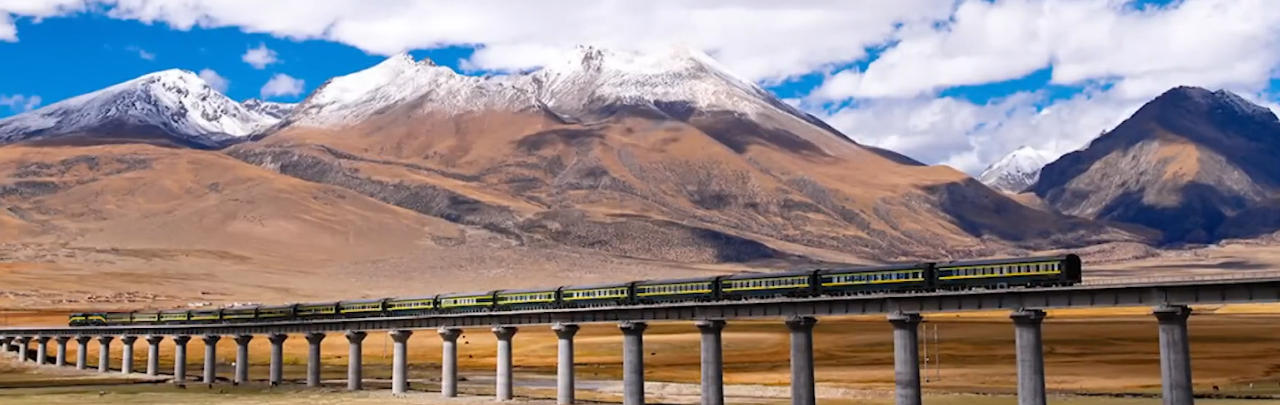
Embark on the world’s highest train journey from Beijing to Lhasa, crossing the legendary “Roof of the World.” The iconic Qinghai–Tibet Railway, also known as the Beijing–Lhasa Railway, is the highest railway on Earth.
The train climbs from 2,829 meters above sea level at Golmud (Geermu) to 3,650 meters at Lhasa. Remarkably, much of the railway is constructed on permafrost, showcasing one of the greatest engineering achievements of modern times.
Its highest point is the breathtaking Tanggula Pass, reaching 5,072 meters (16,640 feet) above sea level.
Because of the high elevation and reduced oxygen levels, all passenger coaches are:
Fully pressurized
Air-conditioned
Equipped with onboard oxygen supply
Therefore, travelers can comfortably enjoy this once-in-a-lifetime journey across the vast Tibetan Plateau.
Before reaching Tibet, the journey includes a fascinating stop in Xian to visit the world-famous Terracotta Army.
This extraordinary archaeological site features thousands of life-sized clay soldiers, horses, and chariots buried with China’s first emperor. It remains one of the most significant discoveries of the 20th century and a UNESCO World Heritage Site.
Your adventure also explores the historical treasures of Beijing, including:
The majestic Forbidden City
The legendary Great Wall of China
These iconic landmarks reflect China’s imperial grandeur and architectural brilliance.
Tibet is a land of dramatic contrasts. From verdant forests to arid, moon-like landscapes shaped by the rain shadow of the northern Himalayas, the region remains as mysterious today as it was centuries ago.
Located at an average altitude of over 3,000 meters, Tibet offers:
Ancient monasteries
Unique Himalayan culture
Vast untouched landscapes
A timeless spiritual atmosphere
Despite modern accessibility, Tibet still preserves the essence of medieval heritage and carries a lingering aura of “Shangri-La.”
✔ Travel on the world’s highest railway
✔ Experience engineering marvels at extreme altitude
✔ Visit Xian’s Terracotta Warriors
✔ Explore Beijing’s Forbidden City & Great Wall
✔ Discover the mystical landscapes of Tibet
Outline Itinerary
Price Details.
Detail Itinerary.
Upon arrival at the airport you will be welcomed by our office representatives who will the transfer you to the hotel in Kathmandu.
Rest of the day at leisure
PAZHUPATINATH:
Lying 6km/4miles from Kathmandu City, Pashupatinath Temple is the holiest Hindu temple dedicated to Lord Zhiva. Zituated amidst a lush green natural setting on the bank of the sacred Bagmati River, the temple is a multi storied temple with gilded roof and richly carved silver door. The sanctum deity is a five faced Zhiva in the form of a lingam. He is also considered as the god of destruction who holds a special position in the Hindu Trinity. Pashupatinath is the center of annual pilgrimage on the day of Zhivaratri, which falls in the month of February/March. It falls on the moonless night where thousands of devotees and sadhu’s from various parts of Nepal as well as India comes to worship lord Zhiva. The festival is observed for one day and one night. Behind the temples are the cremation grounds of the Hindus.
BOUDHANATH:
This Ztupa that is situated 11km/7 miles from Kathmandu City is one of the biggest and holiest Buddhist site in Nepal. It stands with four pairs of eyes in the four cardinal direction keeping watch for righteous behavior and human prosperity. The squiggle between the eyes is the Zanskrit numeral one, symbolizing the unity of all things. This Buddhist Ztupa is believed to have been built by King Man Deva as per the advice of the Goddess Mani Jogini. It is built on an octagonal base. Prayer wheels at the base of the temple are inscribed with the Tibetan mantra ‘Om Mani Padme Hom’. At ground level there is a brick wall with 108 images of meditational Buddha inset behind copper prayer wheels.
Zometimes referred to as “Little Tibet”, Boudhanath is still the best place in the Kathmandu Valley to observe traditional Tibetan lifestyle. The shrine is surrounded by houses of Lamas or Buddhist priests .There are various Tibetan monasteries surrounding Boudhanath Ztupa as it is the focal point of Tibetan Buddhism in Nepal. Boudhanath is a UNEZCO world heritage site, and a destination not to be missed while traveling in Nepal.
Rest of the day at Leisure
It takes around an hour to reach the old city. After checking in at your hotel, you are advised to take rest and take it easy. Drink plenty of fluids and let your body get used to Lhasa’s high altitude. Note: There is no fixed program arranged for today.
Lhasa:
Lhasa has always remained the cultural, political and economic centre of Tibet. The city of Lhasa lies on the north bank of the Lhasa River, a tributary of the Yarlung Tsangpo River, at an altitude of 3,700 meters. Covering an area of 544 sq kilometers and lying at an altitude of 3660 meters, Lhasa is the capital of the Tibet Autonomous Region. The city has a history of over 13 centuries and is synonymous with Tibetan culture and heritage.
The places of interest in Lhasa include the Potala palace, Norbulinka palace, Jokhang temple, Zera and Drepung monasteries etc. The Jokhang temple and Bharkhhor circumambulation circuit , innumerable shops and wayside peddlers selling everything from prayer flags to yak skulls is the most amazing of the experience of being in Tibet.
AM: Breakfast at hotel. An experienced guide will take you on a full day tour.
Zera Monastery:
It is one of the most important Monasteries belonging to the Gelukpa sect of Buddhism in Lhasa. This monastery also serves as the “University Monastery “for those interested in Buddhism. It is about five km north of central Lhasa and was built in 1419. It was the home for 5000 monks in the days of its highest glory, though the number now is reduced to few hundreds. Like Drepung it houses different colleges to teach Buddhist Philosophy. The best time to visit the monastery is in the morning when the monastery is most active, in the debating courtyard you can see the monks debating from 3 to 4 pm. (not weekends)
Jokhang Temple and Bharkhor Zquare:
About 2 km east of Potala and built in 647 AD, Jokhang is the holiest and the most active of the Buddhist temples in Tibet. Jokhang was built by the greatest of the Tibetan King Zhrong Tsong Gompo to house the Buddha image brought from Nepal by his Nepalese wife Bhrikuti. However, another image, the Jowa Zakyamuni, was later moved here by the king’s other wife (the Chinese Princess Wencheng), and it is this image that gives the Jokhang both its name and spiritual potency: Jokhang means ‘chapel of the Jowo’.
Equally interesting is the Bharkhor bazzar that cirles Jokhang. The medieval atmosphere of push and shove of crowd, innumerable shops selling ritual objects, and the never ending pilgrims will take you to its spell. It is here that the heart of the Tibet throbs most.


